


An image I’ll never forget: a woman passing her baby over the wall at the Kabul airport compound. It was August 2021 and the Taliban was sweeping back into Afghanistan. All I could think about was the desperation a mother must feel to do that.
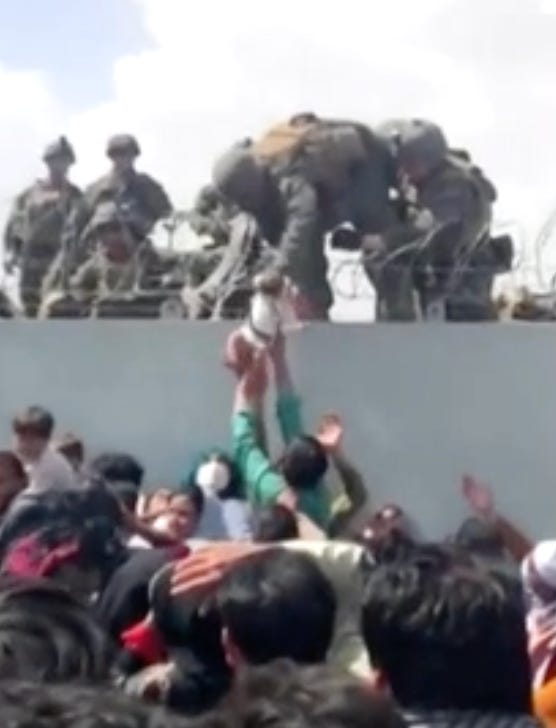
I spent nearly two decades at CIA and left just before the Taliban came back to power. When Kabul fell in August 2021, I was on vacation in France with my one-year-old son. I set up a makeshift command center in our Airbnb’s bathroom, and for two weeks worked phonelines with former colleagues, interpreters, and volunteers to ferry out Afghans who had assisted the U.S. Government.
This Mother’s Day, I want to write about three mothers from that time.
It was just past midnight and I had crawled into bed, desperate to sleep after hours of working exfiltration plans. I picked up my phone one last time and scrolled through a Slack channel of volunteers and saw: U.S. citizen baby stuck in Kabul. I lay there with my eyes closed, telling myself someone else could handle it. But I couldn’t turn my brain off. All I could think about was my own child sleeping peacefully in the next room.
The baby had a U.S. passport but her mother didn’t. She was four months old. To protect her identity, we’ll call her Zahra. Her father was a former U.S. military interpreter. He was in the United States while Zahra and her mother were in Kabul. The mother was unable to get close enough to the airport gates to hold up Zahra’s U.S. passport for safe passage.
The Kabul airport in late August 2021 was bedlam. Thousands of people desperate to enter the airport created chokepoints everywhere. This, along with roving Taliban gangs, made it so people were unable to get close enough to American soldiers guarding the gates for entry. A suicide bomber had killed 180 people outside one of the gates a few days earlier.
The only viable solution was a very selective one, given how many people were rushing the compound. It was a secret gate operated by the CIA. But even that gate was dangerous. The U.S.-affiliated Afghan guards working that gate fired warning shots into the air at anyone approaching as crowd control.
I promised Zahra’s mother they wouldn’t actually shoot her or the baby, even with guns aimed and firing just above their heads.
I had told Zahra’s father explicitly: only the mother and daughter would be allowed entry. When they arrived at the gate, they had Zahra’s uncle in tow, pleading that he be added to the flight manifest to the United States. I had to keep telling them no. Only the wife and baby.
The clock was running out. Afghan men traditionally wield heavy control over their families, and Zahra’s father wasn’t letting his wife and daughter pass through the gate without the uncle. So I had to send this message:
“You hold your world in your hands. You are in charge of your family. You know as well as I do that there are two types of people in this world. Those who wait and those who act. You are the type of person who acts. This is your wife and daughter’s last chance and you hold their future in your hands. If you don’t let your wife and child walk through that open airport gate right now, they will never get a second chance. Your little girl will grow up under Taliban rule and never know her father. You can’t go back. You’ll be killed. They might be killed because of you. I pledge that I will not forget your brother. I will do all in my power to help him. But he will not walk through that gate right now. I’ve spoken to the American soldier and it is not possible and there is nothing that will make it possible. You have only two options right now, and they aren’t negotiable. Let your wife and child proceed. Or leave them behind forever.”
He let them through. Imagine the bravery of Zahra’s mother, pleading with her husband and walking toward gunfire. All for the hope of a future for Zahra outside Taliban rule. A few hours later, Zahra’s mother sent me a picture of her and the baby onboard a U.S. military aircraft. Fortunately, they made it out.
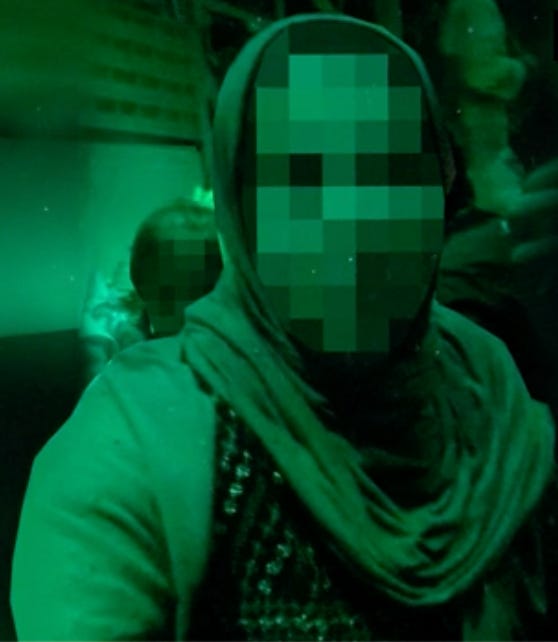
That same week, another family wouldn’t walk through to the gate. They were too terrified of the guards’ guns. I argued with them for thirty minutes, every angle I could think of. I went to the next family on my list. The father was a U.S. Green Card holder. He had sent me a family photo that day, with his Green Card in hand for verification, taken near the CIA gate, along with his wife and three children, all under six years of age. One was a young girl. As I was telling that family it was their turn to walk, the Taliban took over the gates and they didn’t make it through. This second mother now has to raise her daughter under Taliban rule.
That family’s photo is still in my phone’s photo album and sometimes it pops up on my phone’s home screen. I don’t delete it because I don’t want to forget what’s at stake. This is what authoritarianism does. It forces impossible choices.

The third mother I think about on Mother’s Day is one I’ve not met. Her daughter, we’ll call her Zoya to protect her identity, was a 25-year-old NGO worker when Kabul fell.
Because of her strong English skills helping U.S. military contacts and because she provided a safehouse for my CIA interpreter’s family through a network of volunteers, Zoya was offered a way out alone, without her family. She had less than a day to decide. When first offered this opportunity, she told us no. But then she talked to her mother.
Her mother told her she had to go to the United States. That Zoya wasn’t meant for a life under the Taliban. Because the Taliban were moving in quickly to take control of the airport, Zoya had to leave in such a rush that she couldn’t say goodbye to her siblings. Her father got her as far as he could before the streets were blocked and then she ran half a mile through Kabul to make the gate before it closed. Zoya has since graduated from a top American university with a master’s degree. She is building a life here but hasn’t seen her mother and the rest of her family since that tearful goodbye.
A mother passing her baby over a wall. A mother telling her daughter to leave knowing they may never see each other again. A mother trying to get her child out from under Taliban rule. This is the depth of desperation. It is also the depth of love. It is also what authoritarianism makes mothers do.
My son is nearly six now. I tell him America is a country worth being proud of. It is a country worth fighting for. That our great American experiment is durable if we are.
I spent parts of my life in places where authoritarianism is alive and well. I have seen the toll of being jailed or sent to a labor camp for failing to sufficiently praise a country’s leader. I have seen parents whose child was murdered for something as simple as going to school. Sometimes it takes living under authoritarian rule, having to hide, having to compartment aspects of your life, having to go along to get along, to really understand the stakes of creeping authoritarianism.
Many Americans do not understand how good we have it because they have never lived under a dictatorship. The far left is sometimes right about American failures. Where they go wrong is in treating every failure as evidence that the whole project is bad. America is imperfect. That is different from America being broken. Acknowledging what we’ve done wrong is part of becoming better. Treating it as the whole story is how a country talks itself into giving up on itself.
What I worry about most is creeping authoritarianism in America, presented as the solution to our growing polarization. We speak in a language of victimhood and outrage on both sides of the aisle. The biggest threat is that Americans give up on each other. That cynicism can become the operating system of the country if we let it.
I worked in countries where the state routinely called its critics terrorists. Their enforcers didn’t need masks because they had the full backing of the regime. America isn’t there. But when masked federal agents kill Americans in our streets and the reflex is to call the dead domestic terrorists before any facts are in, we have taken a step toward it. We should be very wary of this road.
The march toward authoritarianism doesn’t always announce itself. Some of it is loud, like a killing in the street. Some of it is quieter. It looks like using the courts as a weapon against political opponents instead of a venue for justice. It looks like demanding the right vocabulary before we will hear anyone out. It looks like treating speech as if it were violence, then using that as a license to silence anyone whose views make us uncomfortable. It looks like treating the most extreme example of the other side as proof of what everyone on that side believes.
Some of these are small on their own. But stacked together, over years, this is how a country forgets how to be a country. It is how Americans give up on each other.
It would be sky-is-falling to say we are setting ourselves up for Taliban-style rule. It would also be inaccurate. The risk is something quieter but still un-American. The slow erosion of the thing that makes the United States the place foreign mothers tell their children to walk toward even at gunpoint.
What makes us great is exactly what those mothers were trying to reach. The expectation that a child can grow up safe and have it better than her parents had it.
Mothers have always sacrificed for their children. Afghan mothers walked toward gunfire. The sacrifice this moment asks of American mothers is quieter. It’s refusing to write off half the country. It’s not cheering when the law gets weaponized against someone we don’t like. It’s keeping our common sense when the loudest voices on every side want us to lose it. It’s raising children who can disagree with someone without trying to destroy them.
The defense of the republic has historically been the work of men. Most of the soldiers in most of the wars have been men. The writers of the Constitution were men. Women often get labeled as the soft gender. Too forgiving on immigration. Too quick to sympathize. Too quick to extend a hand to an adversary that would just as soon take it off. Too optimistic to see the hard truths of great power competition.
Some of that critique may carry truth. Coming from CIA and being around our military, however, it is clear to me that American mothers have and continue to take up arms for their country and for their children. There are mothers out there right now on the front lines, some in the shadows at CIA, willing to die not just for our children, but for the country they want to pass on to them.
And we are not soft about our children and their future.
We aren’t soft about a future where they have to practice active shooter drills in school. We aren’t soft about a future where the freedoms our grandparents fought for get traded away by a generation that didn’t earn them.
The work of keeping the republic falls to mothers as much as fathers now. We have voices and we need to be loud. Our children will inherit this country and we need to be clear with them about what is theirs to defend. We need to raise our children to know the difference between a flawed republic and a strongman, and to choose the republic every time.
Somewhere a mother is still holding a baby, hoping there is a country in this world that gives her child a reason to hope. Ours should be that country.
The fathers founded the republic. The mothers may be the ones who keep it.
Happy Mother’s Day.
*Inside CIA, Episode 3, available on Disney and Hulu, covers the exfiltrations mentioned here.
Just beautiful, maddening, compelling, and inspiring. My future rests happily and safely in your head and hart to lead us forward. Keep the press, my fierce friend! 💪🏻
Laura - what a beautifully written piece. Thank you for your thoughts. Happy Mothers day to you.